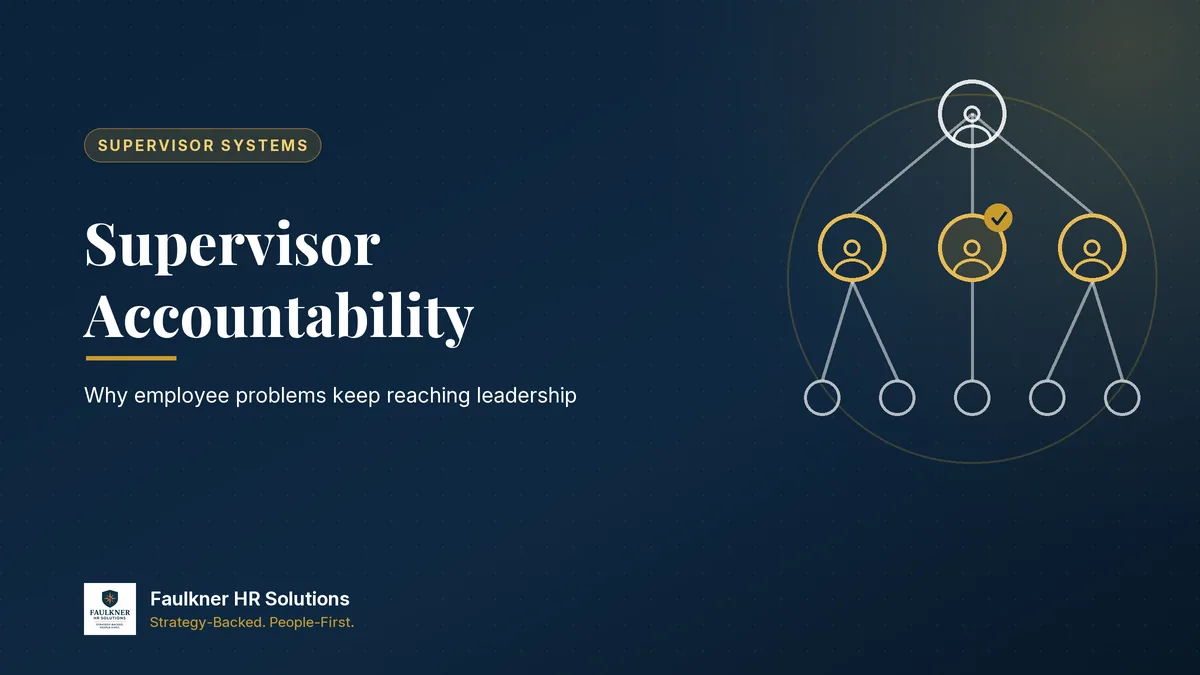
Here is a pattern every owner, executive director, and city manager will recognize. An employee problem — attendance, conflict, performance — surfaces in a department. It travels straight past the supervisor to leadership's desk, arriving late, undocumented, and already inflamed. Leadership handles it, because someone has to. Three weeks later, a different employee problem from the same department makes the same trip.
The tempting diagnosis is bad luck with people: difficult employees, a weak supervisor, a bad quarter. The accurate diagnosis is usually structural. A supervisor problem is often an organizational design problem wearing a management title. The supervisor was promoted for technical skill, handed a team, given no standards for documentation or discipline, no time to manage, no training in the conversations, and no consequences for avoiding them. The organization then acts surprised that problems flow around this person like water around a rock.
This guide is about building the thing that is actually missing: a supervisor accountability system. Not charisma, not leadership platitudes — the specific expectations, tools, reviews, and consequences that make the supervisor layer hold weight.
Why Employee Problems Keep Escalating
Escalation is not a discipline problem among employees. It is a market response. Employees take problems where decisions actually get made. If the supervisor cannot or will not decide — because they avoid conflict, lack authority, or have been overruled twice before — then going around them is not insubordination; it is efficiency.
Watch what the escalation pattern is telling you:
- Problems arrive late. The issue reaching leadership this week started months ago. The supervisor saw it and waited, hoping it would resolve itself. Late problems are avoidance artifacts.
- Problems arrive undocumented. "He's been like this for a year" — with a personnel file that contains a hire date and a W-4. The gap between what supervisors know and what supervisors write down is the single most expensive gap in small-organization HR.
- Problems arrive pre-escalated. Employees skip levels when experience has taught them the level is decorative. If your best people bring complaints straight to you, they are not disrespecting the chain of command. They are describing it accurately.
If leadership is proud of its open door, notice the accounting: every problem that comes through the open door is a problem the supervisor layer failed to absorb — and each one trains supervisors to absorb even less. We wrote about the endpoint of this pattern in Collecting Problems and Calling It Leadership.
The Case for Supervisor Investment, as a Number
Every owner I work with already suspects that some supervisors are better than others. What they usually lack is a way to say how much that matters.
Gallup put the figure at 70% or more across millions of work units. Two teams in the same company, on the same pay scale, under the same handbook, producing different results — the manager explains most of that gap.
Which reframes the budget question. Supervisor development isn’t a nice-to-have sitting alongside pay and benefits. It’s the largest single lever you control, and it’s usually the cheapest.
How Supervisors Create — or Reduce — HR Risk
Supervisors are where policy becomes practice, which means they are where legal risk is manufactured or prevented. Nearly every expensive employment dispute contains one of these supervisor behaviors at its root:
- Inconsistency. Two employees, same conduct, different consequences — because they report to different supervisors. That difference is what a discrimination claim is built from, even when no discrimination happened (the mechanics, here).
- Silence in the file, sudden death in the decision. Years of "meets expectations" reviews followed by a termination for chronic underperformance. The record contradicts the reason, and the record wins.
- Freelance legal judgment. The supervisor who responds to a medical disclosure, a harassment report, or a wage complaint on instinct — instead of stopping and escalating — commits the organization before anyone senior knows there is a situation (what should never be left to untrained managers).
- Retaliation in miniature. The cold shoulder, the worse shifts, the tone shift after a complaint. Supervisors rarely see it as retaliation. Juries reliably do.
The inverse is equally true: a supervisor who documents contemporaneously, applies standards evenly, and escalates the flagged categories is the cheapest risk-reduction instrument an employer can own. The entire question is whether the organization built that supervisor or just hoped for one.
Why Training Alone Does Not Fix It
The standard organizational response to a supervisor problem is a training class. Training matters — but as a component, not a cure. Send a supervisor to a documentation workshop and return them to a system where nobody ever reads the files, spans of control leave no time to write, expectations were never defined, and the colleague who documents nothing gets the same review — and the training will decay in about six weeks, because the system it landed in is unchanged.
Supervisors avoid hard conversations for reasons training does not touch: they have watched leadership overturn discipline before; they were promoted without ever being told people-management was now the job; their span of control makes real supervision arithmetically impossible (check yours with the span of control calculator); and avoidance has never once cost anyone a raise. Those are design conditions. Training a person to overcome a design condition is asking individual willpower to beat organizational physics — occasionally inspiring, never scalable. What works is changing the conditions and then training into them, which is the architecture behind new manager training that actually works.
Measure Supervision, Not Activity
Most supervisor metrics measure whether the supervisor was busy. These measure whether supervision happened.
| Metric | How to calculate it | Warning sign | Review |
|---|---|---|---|
| Turnover by supervisor | Voluntary separations from that supervisor’s team, over average headcount | One supervisor holding a disproportionate share of the organisation’s departures | Quarterly |
| Early-tenure loss | Separations inside 12 months, by supervisor | A cluster under one name — almost always onboarding or supervision, not hiring | Quarterly |
| Documentation currency | Share of the team with a dated note in the last 90 days | Zero notes on a team with performance complaints | Monthly |
| Escalation appropriateness | Issues reaching HR that policy says the supervisor owned | Either extreme: everything escalates, or nothing does | Monthly |
| Overtime concentration | Share of overtime hours held by the top three earners on the team | The same names every period | Per pay cycle |
| Consistency check | Two comparable infractions, compared side by side | Different outcomes with no documented reason | Semi-annually |
| What to tie to advancement | Retention and team satisfaction | If supervision has no consequence, it has no priority | Annually |
The last row is the one that determines whether any of it works. If retention and team satisfaction carry no weight in advancement or pay, supervision is a thing people do after the real work. Tie it to consequence and it becomes the real work.
From our engagement files. A Texas organisation had a turnover pattern nobody wanted to name: newer employees disciplined hard, long-tenured employees untouchable, and no consistent record behind either. Leadership called it a culture problem. It was a supervision problem, and supervision problems do not resolve themselves.
A structured capability assessment identified which supervisors were driving the most departures — objective data rather than impressions. Every supervisor went through mandatory coaching on psychological safety, constructive feedback, and applying standards consistently regardless of tenure. New metrics tied supervisor compensation and advancement directly to retention and team satisfaction. And a dedicated onboarding process for new managers meant the philosophy was set on day one rather than absorbed from the culture that caused the problem.
Voluntary turnover attributable to supervisory practice fell 75% within 18 months. Satisfaction scores on management fairness rose 40 points. Full engagement in our case studies.
How Many People One Supervisor Can Actually Carry
Training a supervisor who has 22 direct reports across two shifts is not a training intervention. It’s a structural problem wearing a training costume.
| Role type | Workable span | Why the number moves |
|---|---|---|
| Frontline, standardised repetitive work (call centre, production floor, retail) | 15–25 | The work is consistent, so supervision is mostly presence and exception handling |
| Frontline, variable or safety-sensitive work (public works, utilities, field crews) | 8–12 | Every shift brings a judgment call; the supervisor is deciding, not just watching |
| Mid-level manager, knowledge work | 6–10 | Coaching load per person is high |
| Knowledge and innovation roles (engineering, product, research) | 5–8 | Work is individualised and cannot be supervised generically |
| Sales and account management | 6–10 | Pipeline coaching is one-to-one by nature |
| Senior executive | 3–7 | Each report owns a function; the load is strategic, not transactional |
| Market average, all levels | 10.9 (2024) → 12.1 (2025) | Spans widened across every management level as organisations flattened |
Spans widened everywhere between 2024 and 2025 — the market average moved from 10.9 to 12.1 as organisations flattened. That’s fine for standardised work. It is not fine for a public works crew where every shift produces a judgment call, and it explains a lot of documentation failures that get blamed on individuals.
Check the ratio before you book the training. Sometimes the answer is a second supervisor, not a better one.
The Documentation and Conversation System
Strip supervisor accountability to its load-bearing core and you get two habits: the supervisor talks to the employee when the problem is small, and writes down that they did. Everything else — reviews, PIPs, discipline, defensible terminations — assembles from those two habits. Building them takes a system with four parts:
- A format that fits the job. Two sentences, same day: what happened and what expectation applies; what was said and what happens next. Supervisors do not avoid documentation because it is hard. They avoid it because nobody defined "done," so every entry feels like drafting a legal document. Give them the floor, not the ceiling — the supervisor documentation sprint installs the habit in thirty days, and this FAQ covers the repeated-issue pattern.
- A conversation structure. The performance conversation needs a repeatable shape: the observed fact, the standard, the gap, the commitment, the follow-up date. Supervisors who have a structure have the conversation; supervisors who must improvise, postpone (the conversation, scripted).
- Escalation triggers in writing. A short list of stop-and-call categories: medical anything, complaint anything, pay anything, safety anything, protected-status anything. The supervisor's job is risk recognition, not legal analysis.
- A review habit. Quarterly, someone senior reads a sample of each supervisor's documentation against the standard — and scores it with the documentation defensibility scorecard. What gets sampled gets done. What never gets read was never really required.
The Supervisor Accountability Checklist
Score your organization honestly — each item is yes or no:
- ☐ Every supervisor has seen, in writing, the people-management duties of their role: documentation, conversations, escalation, consistency.
- ☐ There is a defined documentation standard, and supervisors have the format and the time to meet it.
- ☐ Someone reviews a sample of supervisor documentation at least quarterly.
- ☐ Turnover, complaints, and overtime are tracked by supervisor, and someone looks at the pattern (this is how you spot a failing manager before the exits).
- ☐ Escalation triggers exist in writing, and supervisors can name three of them.
- ☐ People management appears in every supervisor's own evaluation, weighted enough to matter.
- ☐ In the past year, at least one supervisor has experienced a real consequence — positive or negative — tied to how they manage people.
- ☐ When leadership overrides a supervisor's decision, the supervisor learns why, and standards get updated instead of quietly bypassed (and managers who ignore policy get addressed).
Six or more yeses: your supervisor layer is a system — maintain it. Three to five: you have fragments; problems flow through the gaps between them. Fewer than three: leadership is the supervisor layer, whatever the org chart says, and every section of this article is describing your desk.
Frequently Asked Questions About Supervisor Accountability
Because escalation is the rational move when the supervisor layer cannot absorb problems. Supervisors avoid hard conversations they have never been taught to run, document nothing because no one checks, and apply standards inconsistently because no standard was ever defined. Employees learn quickly that real decisions happen above their supervisor — so they go there directly. The fix is not telling employees to use the chain of command. It is making the chain of command capable of holding weight.
Small, factual, and at the time: what happened, when, what expectation applied, what was said, what was agreed, and the follow-up date. Two disciplined sentences written the day of the incident outperform a page of recollection written the week before a termination. The organization's job is to give supervisors a simple format, time to use it, and a review habit that notices when they do not.
Rarely cowardice; usually rational responses to the system around them. They were promoted for technical skill and never taught the conversation. They have watched the organization overturn or soften discipline before, so why spend the relationship capital? They carry spans of control that leave no time. And avoidance has never once been career-limiting. Change those conditions and most supervisors have the conversation.
Training supplies skill; it cannot supply consequences, time, or backup. A supervisor returns from documentation training to the same span of control, the same missing expectations, and the same organization that has never audited a file or corrected a manager for skipping the process. Behavior follows the system, not the seminar. Training works when it is one component of expectations, tools, review, and consequences — and fails as a substitute for them.
Inspect the system, not every decision: define the supervisory duties in writing, review a sample of documentation quarterly, watch the pattern data (turnover, complaints, and overtime by supervisor), and treat people-management performance as part of the supervisor's own evaluation with real consequences both ways. Micromanagement is second-guessing individual calls. Accountability is noticing that one supervisor's team generates triple the complaints — and acting on it.
Building the Supervisor Layer Your Org Chart Promises
Faulkner HR Solutions builds supervisor accountability systems for Texas employers: documentation standards and the training to use them, performance conversation structures, escalation triggers, span-of-control analysis, and the review habits that keep all of it real after we leave. The work lives inside leadership development consulting and supervisor training programs, and often starts with an HR audit that shows exactly where the layer is leaking.
Book a no-cost 30-minute call about your supervisor layer. Bring the checklist score. We will tell you whether the gap is skills, structure, or consequences — and what closing it looks like at your size.
Final Take
Organizations do not get the supervisors they deserve. They get the supervisors they design. If every employee problem still finds its way to the top, stop asking why employees will not use the chain of command and start asking what the chain of command is made of. Expectations, tools, review, consequences — build those four, and most "weak supervisors" turn out to have been strong people in a weightless role.
Next Steps:
- Run the accountability checklist above with your leadership team — separately, then compare answers. The disagreements are the findings.
- Check the arithmetic with the supervisor span of control calculator: some accountability problems are just math.
- If the score was under six, schedule a working call before the next problem makes the trip to your desk.
Disclaimer: This guide is intended for educational purposes and does not constitute legal advice. Always consult with qualified legal and HR professionals for specific guidance.