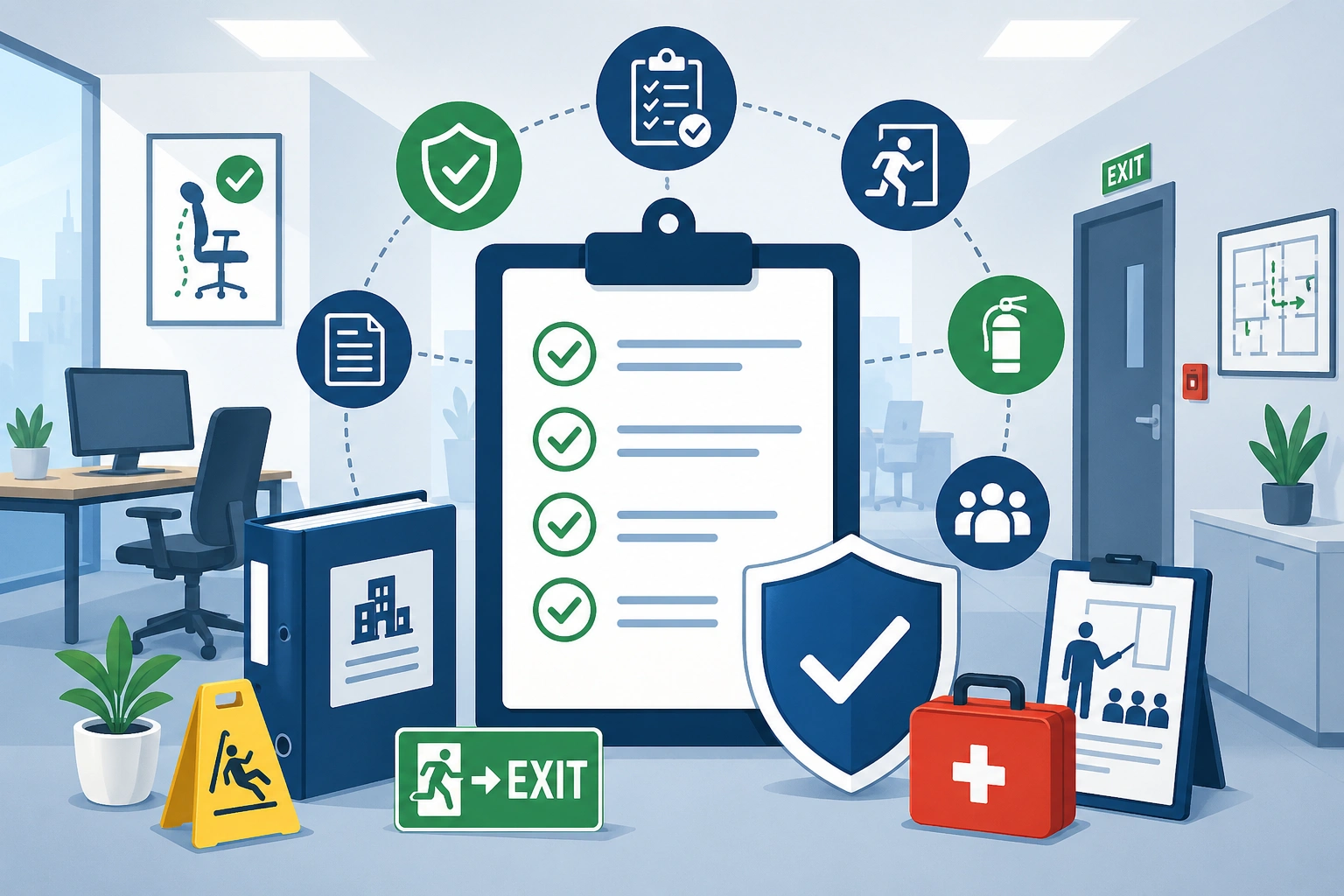
Most organizations assume OSHA belongs on construction sites, warehouse floors, and industrial yards. That assumption creates risk. OSHA office compliance still matters because office environments carry recognized hazards: poor ergonomics, blocked exits, overloaded outlets, slips and falls, weak emergency planning, and inconsistent documentation. The hazards look less dramatic. The liability does not care.
OSHA office compliance requires employers to maintain a safe and healthful workplace, even in low-risk office environments. That means identifying hazards, keeping walkways and exits clear, managing electrical and ergonomic risks, training employees on relevant safety procedures, documenting incidents properly, and maintaining required OSHA postings or records when applicable.
What OSHA Compliance Means in an Office Setting
OSHA office compliance refers to the legal and operational responsibility to maintain a safe workplace in an office environment. That includes hazard identification, employee protection, documentation, emergency response, and corrective action. Office employers do not get a pass because employees sit at desks instead of operating machinery.
The difference is not whether OSHA applies. The difference is how it applies. In offices, risk usually shows up through ergonomic strain, walking-working surface hazards, electrical problems, fire safety gaps, indoor environmental concerns, and weak incident reporting. None of those are solved by a binder on a shelf.
Operational reality: OSHA compliance is not a paperwork hobby. It is a control system. If nobody owns the process, the process does not exist in any meaningful way.
OSHA Office Compliance Checklist
Use this checklist as a baseline office safety audit. It is intentionally practical. The goal is not to create a museum-quality safety manual. The goal is to see whether the workplace is actually controlled.
Workplace Safety
- Walkways are clear and unobstructed
- Floors are dry, stable, and maintained
- Lighting is adequate in work areas and exits
- Furniture is stable and safely arranged
Ergonomics
- Chairs support neutral posture
- Monitors are positioned near eye level
- Keyboard and mouse placement reduces strain
- Employees know how to adjust workstations
Electrical Safety
- Outlets are not overloaded
- Power strips are used correctly
- Damaged cords are removed from service
- Extension cords are temporary, not permanent wiring
Emergency Readiness
- Exit routes are clearly marked
- Exits are not blocked
- Emergency procedures are communicated
- Fire extinguishers are inspected when required
Why OSHA Compliance Still Matters in Offices
Office environments do not eliminate risk. They shift it. A warehouse hazard may be obvious because a forklift is moving through the aisle. An office hazard is usually boring right up until someone gets hurt, files a complaint, or asks for records the organization cannot produce.
The most common office safety problems are predictable: poor ergonomics, blocked exits, overloaded circuits, loose carpet, wet floors, poor lighting, missing incident documentation, and inconsistent reporting. The pattern is rarely catastrophic at first. It accumulates quietly.
That is the part leaders miss. Compliance exposure usually does not begin with a dramatic failure. It begins when small risks are normalized because nobody has been assigned to notice them.
Core OSHA Standards That Apply to Office Environments
Office employers should understand the standards that most often create operational risk in a low-hazard workplace. These are the areas that deserve the first review.
1. General Duty Clause
The General Duty Clause requires employers to provide a workplace free from recognized hazards that could cause death or serious physical harm. In offices, that can include ergonomic hazards, unsafe furniture, environmental issues, or conditions that leadership knew about and failed to address.
2. Walking-Working Surfaces
Walking-working surface issues include loose carpeting, wet floors, cluttered walkways, poor lighting, and unsafe stairs. Slip, trip, and fall risks are not minor simply because the floor is carpeted and the injury happens beside a printer.
3. Electrical Safety
Office electrical risk usually comes from overloaded outlets, daisy-chained power strips, damaged cords, and extension cords used as permanent wiring. These issues are common because offices quietly add equipment without redesigning the electrical setup.
4. Fire Safety and Emergency Action Plans
Emergency plans must be usable. If employees do not know where to go, who gives instructions, or how to respond during an evacuation, the plan is decoration. Clearly marked exits, unobstructed routes, communicated procedures, and assigned responsibilities matter.
5. OSHA Recordkeeping
Not every office is required to maintain OSHA logs, but some are depending on size and industry classification. When recordkeeping applies, employers need OSHA 300, 300A, and 301 records maintained properly. Serious incident reporting obligations may still apply even when routine logs do not.
Which Standards Actually Reach an Office
“We're an office, OSHA doesn't really apply to us” is one of those beliefs that survives right up until an inspector walks the exit routes.
| Standard | Applies in an office? | What it requires |
|---|---|---|
| Emergency action plans — 1910.38 | Yes, if any standard requires an EAP | Written plan where you have 11 or more employees; evacuation routes, procedures, alarm, training |
| Fire prevention plans — 1910.39 | Yes, where required | Written where 11 or more employees; hazard list, control measures, maintenance |
| Portable fire extinguishers — 1910.157 | Usually | Mounting, inspection, annual maintenance, and training where employees are expected to use them |
| Exit routes — 1910.36 and .37 | Yes | Unobstructed, adequate in number, properly marked and lit |
| Electrical — 1910.303 onward | Yes | Covers the daisy-chained power strips under every desk cluster |
| Walking-working surfaces — 1910.22 | Yes | Clean, orderly, dry; the standard behind most slip and trip citations |
| Hazard communication — 1910.1200 | Sometimes | If cleaning chemicals, toner or maintenance products are used beyond consumer quantities |
| Ergonomics | No standard | There is no OSHA ergonomics standard. Exposure runs through the General Duty Clause, sec. 5(a)(1), where a hazard is recognised and causing serious harm |
| Recording work-related injuries — 1904 | Yes, unless exempt | A repetitive strain injury that requires treatment beyond first aid is recordable |
Two lines deserve attention.
There is no OSHA ergonomics standard. That surprises people in both directions — it means OSHA can't cite you against a specific ergonomic rule, and it also means a recognised, serious ergonomic hazard can still be cited under the General Duty Clause. Both things are true.
And the electrical standards do apply. Walk any office and you'll find surge protectors chained together under a desk cluster. That's a citable condition, and it's the one an inspector can see from the doorway.
Before an inspector does it for you: the HR System Risk Diagnostic scores whether your reporting and records would hold up, and the Workers’ Comp Incident Cost Calculator prices a single office injury once direct and indirect costs are counted.
What an OSHA Citation Costs in 2026
Two numbers worth committing to memory, because everything else scales off them.
| Violation type | Maximum penalty | What triggers it |
|---|---|---|
| Other-than-serious | $16,550 per violation | A condition related to safety and health, unlikely to cause serious harm |
| Serious | $16,550 per violation | Substantial probability of death or serious physical harm, and the employer knew or should have known |
| Failure to abate | $16,550 per day past the abatement date | The cited hazard is still there when OSHA returns |
| Wilful | $165,514 per violation | Intentional disregard, or plain indifference to the requirement |
| Repeated | $165,514 per violation | A substantially similar violation cited within the previous five years |
| Wilful violation causing a death | Criminal referral possible in addition to civil penalty | Section 17(e) of the OSH Act |
Small note with real consequences: OSHA published no inflation adjustment for 2026, so the amounts set on 15 January 2025 are still the ceiling. That's unusual — the figures normally move every January — and it means guidance you find quoting a 2026 increase is wrong.
The row to watch is repeated. A substantially similar violation cited within five years jumps from $16,550 to $165,514. That's a tenfold move for the same hazard you were told about once and didn't fix.
Common OSHA Compliance Mistakes in Office Environments
1. Treating Safety as Common Sense
Common sense is not a control system. Supervisors will interpret hazards differently unless expectations are defined. That inconsistency is where liability starts building.
2. Assigning Safety to Everyone
When safety is everyone’s responsibility, it often becomes no one’s responsibility. Every OSHA-related process needs a named owner, a reporting path, and a deadline for correction.
3. Waiting for an Injury Before Acting
Reactive safety management is not management. If the office only responds after an injury, complaint, or near miss, the organization is using employees as the detection system.
4. Weak Documentation
If a hazard is reported but not documented, the organization cannot show what was known, who reviewed it, what corrective action occurred, or whether the issue was resolved. For related documentation practices, see employee documentation best practices for legal defense.
5. Ignoring Ergonomics
Ergonomic injuries are easy to dismiss because discomfort often builds slowly. That does not make the risk imaginary. It makes the risk easier to ignore until productivity, morale, and claims start telling a different story.
How to Conduct an OSHA Office Compliance Audit
Most offices do not need a thicker policy manual. They need visibility. An effective OSHA office compliance audit reviews the actual workplace, the actual behavior, and the actual documentation.
Identify High-Risk Areas
Start with high-traffic areas, employee workstations, storage rooms, shared equipment areas, hallways, stairs, breakrooms, and any department with prior incidents or complaints.
Observe Actual Behavior
Do not rely on written policy. Watch how people use equipment, route cords, respond to spills, report hazards, adjust workstations, and move through the office.
Review Documentation
Check incident reports, OSHA logs if required, safety training records, inspection records, hazard reports, corrective action notes, and emergency planning records.
Evaluate Ownership
Ask who owns safety, who receives hazard reports, who approves corrective action, and how quickly hazards are resolved. If the answer changes by department, the system is already compromised.
The Real Problem: OSHA Compliance Is a System Issue
Organizations often treat OSHA compliance as a checklist. That approach fails because compliance is not just about having the right forms. It is about having a system that executes consistently when people are busy, distracted, understaffed, or under pressure.
The same pattern appears in broader HR operations: inconsistent processes, undefined ownership, weak documentation, reactive decision-making, and supervisors improvising because the system never told them what good looks like. For the deeper operational connection, see HR process improvement.
Office safety breaks the same way onboarding, documentation, and employee relations break. The organization assumes people know what to do. Then leadership acts surprised when they do not.
Case Insight: Office Safety Breakdown Pattern
In practical audits, the same pattern appears across organizations. Safety policies exist. Employees have general awareness. Supervisors handle issues differently. Documentation is inconsistent. Hazards are addressed after escalation rather than through a defined process.
The result is predictable: higher incident risk, weaker compliance posture, frustrated employees, and leadership with no clean view of workplace risk. That is not a training problem by itself. It is a system design problem.
When to Engage OSHA Compliance Support
Outside support makes sense when safety practices vary by department, documentation cannot support decisions, incidents are increasing without clear cause, leadership lacks visibility into workplace risk, or growth has outpaced informal safety practices.
Faulkner HR Solutions helps Texas employers connect compliance requirements to the operational systems that actually make compliance possible. Related services include HR compliance consulting, HR audit consulting, and employee handbook and policy consulting.
OSHA Office Compliance FAQ
Yes. OSHA applies to most private-sector employers, including office-based organizations. The standards and risks look different from industrial environments, but employers still need hazard prevention, safety procedures, documentation, and employee communication.
Office compliance usually includes hazard identification, clear walkways and exits, electrical safety, emergency procedures, relevant employee training, and proper injury documentation when OSHA recordkeeping requirements apply.
It depends on size and industry classification. Some small employers are exempt from routine OSHA recordkeeping, but serious incident reporting rules may still apply.
OSHA does not maintain a broad office ergonomics standard, but recognized ergonomic hazards may still create employer responsibility under the General Duty Clause.
At minimum, annually. High-growth offices, recently reorganized workplaces, or offices with recurring complaints or incidents should review hazards and documentation more frequently.
Final Takeaway
OSHA compliance in office environments is not complex. It is operational. Most organizations already know the basics: keep exits clear, prevent hazards, train people, document incidents, and fix problems quickly. The failure is execution.
No ownership creates inconsistency. No process creates delay. No documentation creates risk. Fix the system and compliance becomes manageable. Ignore the system and the same hazards keep returning under different names.
Schedule a no-obligation strategy call or call 210.446.8730 to review whether your office safety, documentation, and HR compliance systems are holding up under real operating conditions.
Related HR Questions, Answered
Direct answers from our HR FAQ library for Texas employers: