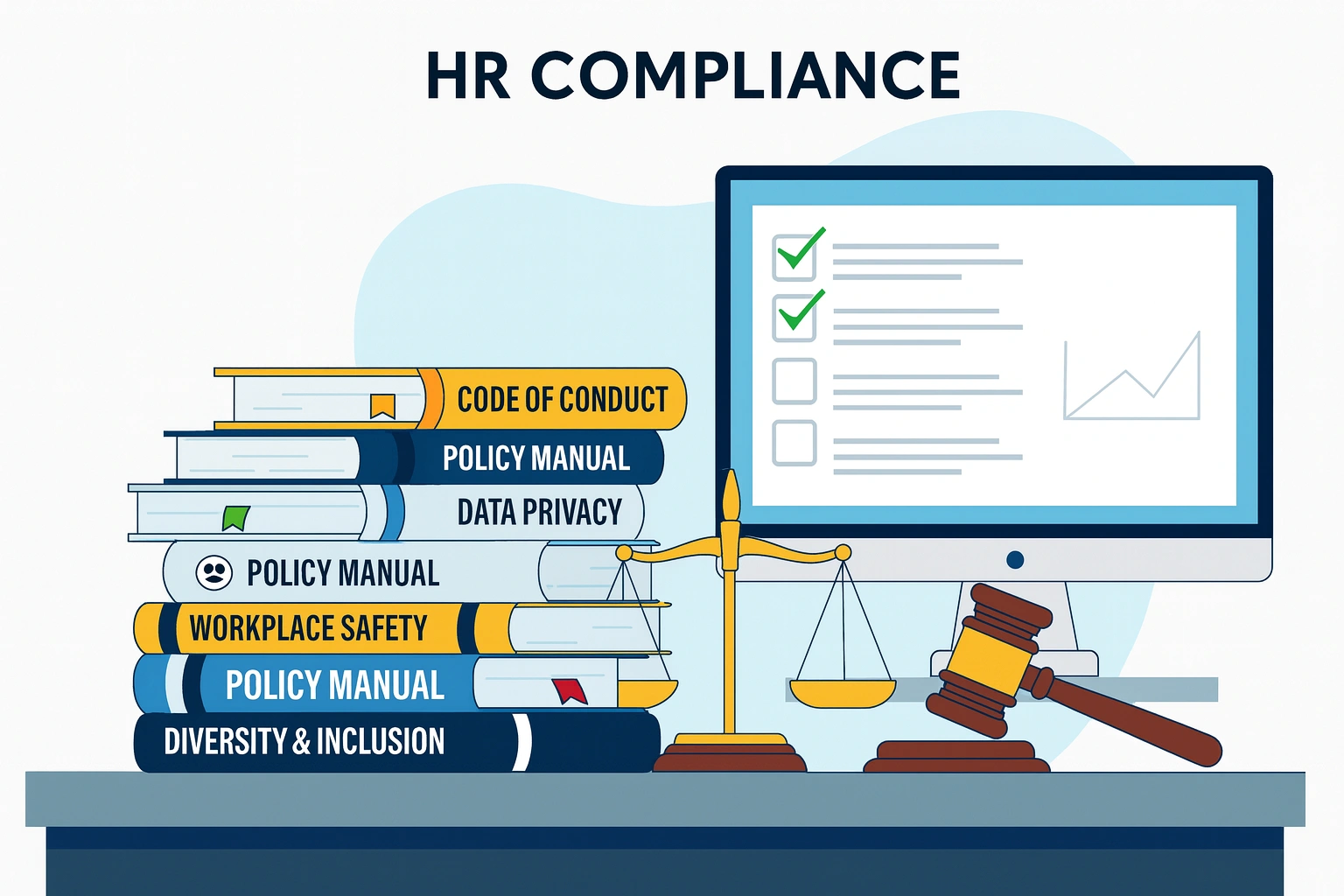
HR compliance services in Texas help employers review policies, strengthen documentation, train managers, correct compliance gaps, and reduce legal risk tied to wage and hour issues, employee relations, leave administration, and inconsistent employment practices. The strongest firms do not just hand over a handbook or send out a training deck. They help build repeatable systems that support consistent decisions and defensible employment actions.
That distinction matters. Many organizations believe they have a compliance process because they updated a policy once, bought a template handbook, or told supervisors to “be careful.” That is not a compliance system. In practice, the organizations that struggle most with compliance usually have the same underlying problem: policy language exists, but the infrastructure needed to apply it consistently does not.
HR compliance services in Texas help employers review policies, strengthen documentation, train managers, correct compliance gaps, and reduce legal risk tied to wage and hour issues, employee relations, leave administration, and inconsistent employment practices.
This guide explains what HR compliance services Texas employers actually need, where employment law compliance Texas issues usually emerge, how HR risk management works in practice, and where HR audit services and workplace compliance services fit into a stronger operating system.
If compliance depends on memory, personality, or a manager “knowing better,” the organization does not have a compliance system. It has a liability pattern waiting to show itself.
What HR Compliance Services in Texas Should Actually Include
Effective HR compliance services in Texas go well beyond policy drafting. Employers need a structure that aligns legal obligations with day-to-day behavior, documentation, supervision, and recordkeeping. At minimum, that means reviewing written policies, auditing actual practices, identifying process breakdowns, and correcting the gaps between what the handbook says and what managers actually do.
A strong engagement often includes policy and handbook review, documentation standards, manager training, wage and hour review, corrective action workflow design, complaint response structure, and ongoing monitoring. The goal is not just to satisfy a legal standard on paper. The goal is to create a system that holds up when an employee complaint, leave issue, wage dispute, or disciplinary challenge appears.
Six Ways to Buy HR, and What Each One Actually Is
These get used interchangeably in conversation and they are not interchangeable at all.
| Provider | What they do | How they price | When it fits | What they will not do |
|---|---|---|---|---|
| HR consultant | Diagnose and build systems, then hand them over | Project fee or hourly | You need something fixed or built once | Run your day-to-day HR forever |
| Fractional HR / retainer | Ongoing senior judgment without a full-time seat | Monthly retainer, often per employee | You need decisions, not headcount | Sit in your office five days a week |
| PEO | Co-employment. Becomes employer of record for certain purposes; runs payroll, benefits, workers’ comp | 2–12% of payroll, or roughly $40–$200 per employee per month | You want benefits buying power and transactional HR handled | Fix a supervision problem or defend a termination decision |
| ASO | Same administrative services, no co-employment | Typically 2–8%, or a flat per-employee fee | You want the admin without sharing employer status | Assume employer liability |
| Employment attorney | Advises on legal risk and defends claims | Hourly, usually the highest rate on this list | A claim has been filed, or a decision carries real legal exposure | Build the process that stops claims arising |
| Recruiter | Fills open roles | Percentage of first-year salary | You need people hired | Anything after the start date |
The most common expensive mistake in this table is buying a PEO to solve a supervision problem. A PEO will run your payroll beautifully and will not make your supervisors document a write-up. Different problem, different purchase.
HR Compliance Consulting vs. One-Time Policy Review
Many employers confuse a policy refresh with a compliance strategy. A one-time review may update language, but it does not usually fix the operating conditions that create risk. HR compliance consulting is broader. It examines whether managers understand policy expectations, whether documentation practices are consistent, whether corrective action steps are applied evenly, and whether employment decisions can be defended when challenged.
A policy can be technically correct and still fail in practice. That happens when supervisors are untrained, documentation is inconsistent, processes are unclear, or expectations shift depending on who is involved. Good consulting addresses the structure behind the document, not just the document itself.
Employment Law Compliance in Texas: Where Employers Usually Get Exposed
Employment law compliance Texas issues tend to cluster in predictable places. Employers often underestimate wage and hour exposure, mishandle leave and accommodation conversations, rely on outdated handbook language, fail to maintain complete hiring records, or allow discipline to become inconsistent across managers and departments.
Texas employers also operate in an environment where practical precision matters. At-will employment does not excuse weak documentation. A policy being written down does not mean it is enforced consistently. Growth does not reduce compliance risk; it usually multiplies it. As headcount rises, informal practices that once seemed manageable begin to fracture.
- Wage and hour mistakes tied to exempt classification, timekeeping, or off-the-clock work
- Incomplete or inconsistent personnel documentation
- Outdated handbook language that does not reflect current practice
- Manager decisions that create retaliation, discrimination, or inconsistency risk
- Weak leave administration and poor complaint response processes
- Investigation and corrective action practices that are undocumented or uneven
Most compliance problems do not begin with a lawsuit. They begin earlier, when a preventable documentation gap, manager mistake, or broken process goes unchecked long enough to become a pattern.
HR Audit Services and Employment Law Compliance in Texas
HR audit services are especially useful when an organization is growing, changing leadership, updating policies, or dealing with recurring employee relations issues. A good audit creates a clearer picture of where exposure exists and whether written standards match actual operations.
The strongest audits do not stop at a checklist. They examine handbook language, wage and hour practices, documentation quality, complaint handling, leave administration, onboarding records, corrective action structure, and manager behavior. The goal is not a long report that gets ignored. The goal is a prioritized correction plan tied to real operational changes.

HR Risk Management Requires More Than Legal Language
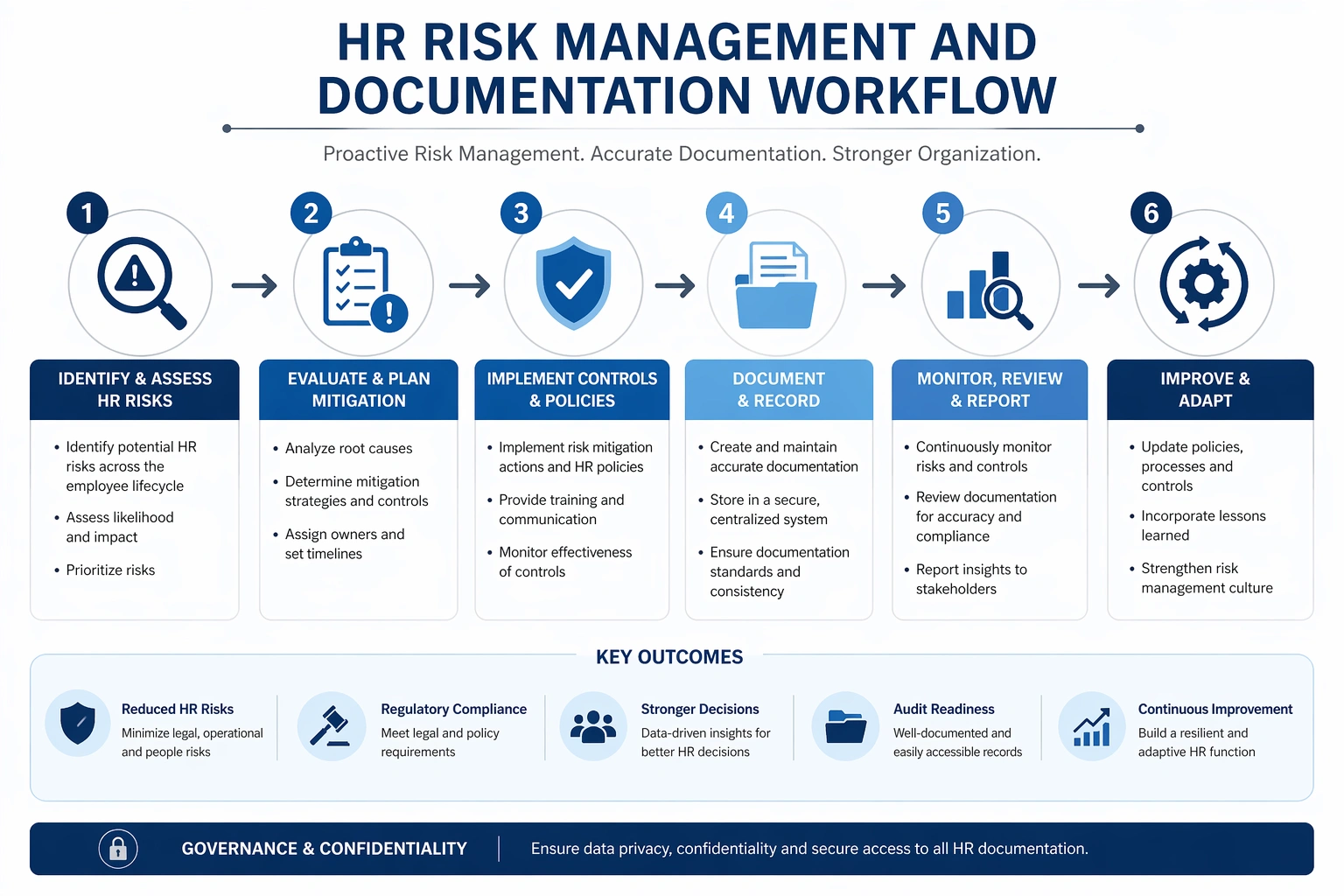
HR risk management is not just about avoiding obvious legal mistakes. It is about reducing the odds that ordinary management activity turns into conflict that the organization cannot defend well. That requires decision-making structure, training, escalation paths, and records that show consistency over time.
For many employers, the risk is not that nobody cares about compliance. The risk is that nobody has translated compliance into a usable operating model. A supervisor is expected to manage attendance, conduct coaching, respond to complaints, and document performance issues without a system that guides those actions. That creates drift. Drift becomes inconsistency. Inconsistency becomes exposure.
What Workplace Compliance Services Should Include
Workplace compliance services should support the full employee lifecycle, not just isolated legal topics. That includes hiring, onboarding, training, performance management, documentation, leave administration, investigations, corrective action, separation processes, and policy communication. When only one piece is addressed, the rest of the system keeps producing the same avoidable failures.
A mature compliance structure often includes:
- Policy and handbook review for legal alignment and operational clarity
- Documentation standards for performance, conduct, and employee relations issues
- Manager training focused on real-world scenarios, not passive click-through modules
- Wage and hour review tied to actual work practices
- Complaint intake and investigation response structure
- Corrective action and termination process consistency
- Periodic monitoring to catch new gaps before they spread
Who Needs HR Compliance Services in Texas?
Organizations usually need HR compliance services in Texas when complexity has outgrown informal management. That may be a small business making its first significant hires, a nonprofit with inconsistent documentation practices, a municipality dealing with outdated policy infrastructure, or a growing company where supervisors are making employment decisions without enough structure.
Common signs that support is needed include repeated employee relations issues, uneven discipline, uncertainty around documentation, policy language no one follows, confusion around leave or accommodations, and leadership concern that the organization is one complaint away from a more serious problem.
Small businesses adding structure, nonprofits trying to modernize, municipalities cleaning up inconsistent practices, and private-sector employers whose managers have too much responsibility and too little process support.
What HR Compliance Services in Texas Look Like in Practice
Consider a Texas employer with outdated policies, uneven supervisor practices, incomplete disciplinary records, and rising employee relations friction. On the surface, none of the issues may appear catastrophic. In aggregate, though, the organization is operating with stacked vulnerabilities. One leave complaint, one termination challenge, or one wage issue can force every weak point into the open at once.
An effective engagement would begin with HR audit services to identify the gaps, followed by policy modernization, documentation standards, manager training, and a more reliable process for escalations and employee actions. That is what separates surface cleanup from real HR risk management. The outcome is a system that is more consistent, more defensible, and less likely to break under ordinary management pressure.
What a Compliance Engagement Should Leave Behind
The test of a compliance engagement isn’t the report. It’s what your team can do six months after the consultant has gone.
| Deliverable | What you receive | How you know it worked |
|---|---|---|
| Findings register | Every gap found, rated by exposure and effort to close | You can hand it to a successor and they know what to do |
| Policy and handbook remediation | Rewritten language with the reason for each change noted | A supervisor can apply the policy without calling anyone |
| Personnel file structure | Separated medical, I-9 and investigation files with an access rule | A records request does not require opening every folder |
| Supervisor documentation standard | One format, with worked examples | Two supervisors document the same incident the same way |
| Wage-and-hour review | Workweek definition, exemption tests, timekeeping practice | You can reconstruct a specific employee’s specific week on request |
| Leave administration workflow | Named owner, deadlines, forms, tracking method | The 5-business-day and 15-calendar-day clocks are somebody’s job |
| Remediation sequence | What to fix first, and who owns each item | Progress is visible without another engagement |
Read the right-hand column rather than the middle one. “A supervisor can apply the policy without calling anyone” is a testable claim. “Updated handbook” is a deliverable that can be true while nothing has changed.
If a proposal cannot tell you how you’ll know it worked, that’s worth raising before you sign it.
See where you’d land today: the HR System Risk Diagnostic scores your current state across these areas, and the Employee Handbook Risk Score rates the policy document itself.
The Cost of Not Fixing Weak Compliance Systems
The cost of weak HR compliance is rarely limited to legal fees. Employers also absorb hidden costs through manager inconsistency, preventable turnover, rework, employee distrust, delayed investigations, and leadership time pulled into issues that stronger systems could have prevented. Weak compliance systems drain attention long before they create a formal claim.
Score your exposure first: the Employer Decision Risk Scorecard rates where a decision would fail review, and the Documentation Defensibility Scorecard tests a live personnel file. Both take minutes and neither needs a conversation with us.
Common Mistakes That Undercut Compliance
- Using generic policies that do not reflect Texas operations or current practice
- Assuming legal review alone solves operational inconsistency
- Leaving supervisors to interpret policy without practical training
- Failing to standardize documentation expectations
- Waiting for a complaint, claim, or audit before addressing obvious gaps
- Treating compliance as a one-time cleanup instead of an ongoing management system
Implementation Checklist for HR Compliance Services Texas Employers Can Use
- Conduct an HR audit to identify policy, documentation, and process gaps
- Review handbook and policy language for legal alignment and operational clarity
- Evaluate wage and hour practices, documentation standards, and supervisor consistency
- Train managers on documentation, complaint handling, corrective action, and escalation
- Standardize how employee issues are recorded, reviewed, and resolved
- Improve investigation, leave, and corrective action processes where risk is recurring
- Schedule periodic review so new compliance gaps do not accumulate unnoticed
How This Connects to Broader HR Infrastructure
Compliance is rarely isolated. Weak documentation affects investigations. Weak onboarding affects policy enforcement. Weak manager accountability affects discipline, morale, and risk exposure. That is why many organizations benefit from pairing HR audit services with broader support such as employee handbook consulting, hiring and onboarding process design, and organizational development consulting.
If the problem is recurring, the real fix is rarely another memo. It is a better system. Employers looking to learn more about HR compliance services in Texas should focus on whether the support being offered improves documentation, supervisor consistency, policy usability, and operational follow-through.
For additional guidance, explore employee documentation best practices for legal defense, change management in HR, and HR challenges for small Texas cities.
Frequently Asked Questions
HR compliance services in Texas typically include policy and handbook review, HR audit services, documentation review, manager training, wage and hour compliance review, corrective action process review, and ongoing monitoring to reduce legal exposure.
An HR audit identifies compliance gaps and documentation weaknesses. HR compliance consulting goes further by helping the organization correct those gaps, modernize policies, train managers, and build systems that reduce future risk.
Texas employers should consider HR compliance consulting when policies are outdated, documentation is inconsistent, managers are making employee decisions without training, the organization is growing quickly, or recurring employee relations issues suggest system failure.
Common employment law compliance issues in Texas include wage and hour mistakes, incomplete documentation, inconsistent discipline, outdated handbooks, weak leave administration, poor manager training, and failures in investigation or complaint response processes.
HR compliance services reduce legal risk by improving policy clarity, standardizing documentation, identifying vulnerabilities early, training supervisors, and creating repeatable systems that support defensible employment decisions.
Yes. HR audit services help reduce compliance risk by identifying policy gaps, documentation weaknesses, inconsistent employment practices, and manager-level process failures before those issues escalate into claims or agency problems.
Most organizations do not need more compliance theater. They need stronger documentation, clearer expectations, better manager training, and systems that reduce preventable risk. That is the real value of HR compliance services in Texas.
Related HR Questions, Answered
Direct answers from our HR FAQ library for Texas employers: