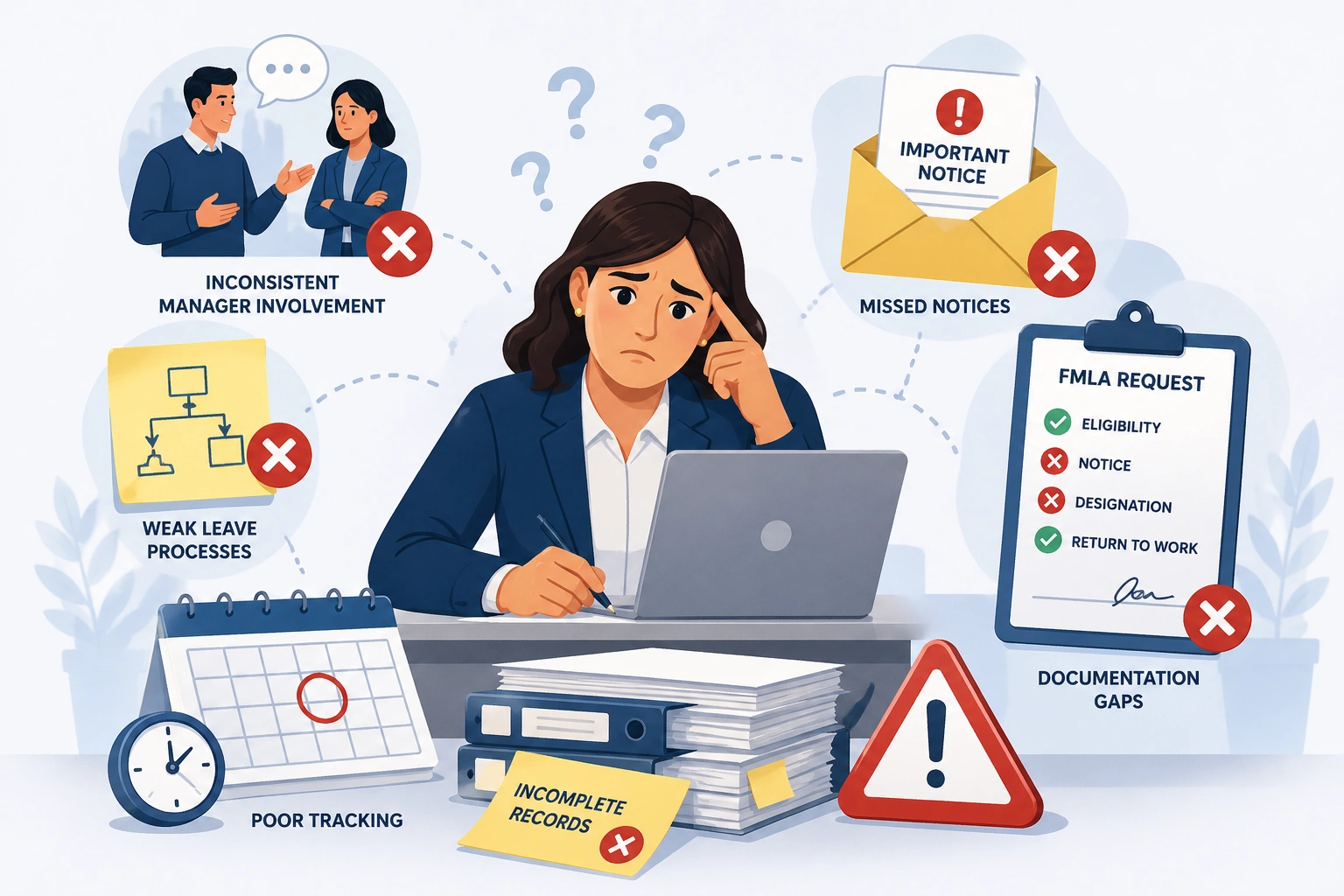
FMLA administration fails when employers treat protected leave like a form instead of a system. The Family and Medical Leave Act requires more than knowing the law exists. Employers must identify qualifying situations, determine eligibility, provide required notices, track leave accurately, protect job restoration rights, and document the process from start to finish.
That is where many employers get exposed. The organization may have an FMLA policy in the handbook, but the actual process depends on a supervisor remembering to tell HR, a spreadsheet being updated correctly, or one person knowing where the forms are saved. That is not compliance. That is hope with a file folder.
The most common FMLA mistakes employers make include misidentifying eligibility, failing to provide required notices, mishandling intermittent leave, allowing supervisors to make leave decisions, missing deadlines, and failing to document decisions consistently. These mistakes create legal risk because FMLA compliance is process-driven. If the workflow is inconsistent, the compliance outcome will be inconsistent.
What Is FMLA Compliance?
FMLA compliance is the employer’s ability to properly administer job-protected leave for eligible employees under the Family and Medical Leave Act. The U.S. Department of Labor explains that FMLA provides eligible employees of covered employers with unpaid, job-protected leave for qualifying family and medical reasons while requiring group health benefits to continue under the same terms and conditions as if the employee had not taken leave.
For employers, compliance includes more than approving time away from work. It includes determining whether the employer is covered, whether the employee is eligible, whether the reason qualifies, whether proper notices were issued, whether leave was designated correctly, whether benefits continued, whether the employee was restored properly, and whether documentation supports the decision.
In practical terms, FMLA compliance is a workflow. When that workflow is informal, decentralized, or manager-dependent, mistakes become predictable.
Why Employers Make FMLA Mistakes
Most FMLA mistakes employers make come from operational design failures rather than complete ignorance of the law. Employers know FMLA exists. The problem is that their internal system cannot execute the law consistently.
FMLA requires several connected actions:
- Recognizing when an absence may trigger FMLA obligations
- Determining employee eligibility
- Providing timely notices
- Requesting and reviewing certification
- Designating protected leave
- Tracking leave usage
- Managing intermittent leave
- Protecting job restoration rights
- Coordinating FMLA with ADA, workers’ compensation, PTO, and attendance policies
Each step creates a failure point. If no one owns the full workflow, the process breaks in pieces.
A handbook policy does not administer FMLA. A trained supervisor does not administer FMLA. A shared spreadsheet does not administer FMLA. A defined leave process administers FMLA.
The Most Common FMLA Mistakes Employers Make
The mistakes below are the patterns that most often create legal exposure, employee distrust, and administrative rework.
1. Misidentifying Employee Eligibility
Employees are generally eligible for FMLA when they work for a covered employer, have worked for the employer for at least 12 months, have at least 1,250 hours of service during the 12 months before leave begins, and work at a location where the employer has at least 50 employees within 75 miles.
Employers make mistakes when eligibility is checked manually, inconsistently, or too late in the process. Some employers assume an employee is not eligible because the employee has not worked 12 consecutive months. Others fail to verify hours worked or misunderstand the 50-employee/75-mile rule.
Risk: The employer may deny protected leave incorrectly, grant leave without proper designation, or create inconsistent treatment between employees.
2. Missing Required FMLA Notices
FMLA requires employers to provide specific notices during the leave process. These include the eligibility notice, rights and responsibilities notice, and designation notice. The Department of Labor states that employers must provide an eligibility notice within five business days of the initial request for leave or when the employer learns that leave may be for an FMLA-qualifying reason.
Employers miss notices when no trigger exists in the workflow. Someone hears about a medical issue, assumes the employee will “handle it,” and no formal process begins. That is where exposure starts.
Risk: Failure to provide required notices may support claims that the employer interfered with, restrained, or denied FMLA rights.
3. Waiting for the Employee to Say “FMLA”
Employees do not need to use the phrase “FMLA” to trigger employer obligations. If the employer has enough information to reasonably understand that the absence may qualify for protected leave, the employer should begin the FMLA review process.
Common trigger statements include:
- “I need surgery.”
- “My doctor says I cannot work for a while.”
- “My spouse needs care after a serious medical issue.”
- “I keep having flare-ups and need time off.”
- “I am pregnant and need medical appointments.”
Risk: Treating possible protected leave as ordinary attendance creates unnecessary legal exposure.
4. Letting Supervisors Make FMLA Decisions
Supervisors should not independently decide whether an employee qualifies for FMLA, whether medical documentation is sufficient, whether leave should be approved, or whether absences should count against the employee. Supervisors should report information to HR and follow the established process.
Manager involvement becomes dangerous when supervisors are given responsibility without boundaries. A supervisor may be trying to manage staffing, but staffing frustration is not a lawful reason to interfere with protected leave.
Risk: Inconsistent supervisor decisions create retaliation, interference, and disparate treatment concerns.
5. Mishandling Intermittent FMLA Leave
Intermittent FMLA is one of the most difficult leave issues to administer because employees may take leave in separate blocks of time for a qualifying reason. The challenge is not simply approving the leave. The challenge is tracking usage accurately while applying call-in procedures consistently.
Employers struggle with intermittent leave when:
- Leave usage is tracked manually
- Supervisors approve or deny absences informally
- HR does not receive real-time absence information
- Attendance points are applied incorrectly
- Recertification is not tracked
Risk: The employer may overcount leave, undercount leave, punish protected absences, or lose the ability to defend attendance decisions.
6. Poor Documentation of Leave Decisions
FMLA documentation should show what the employer knew, when the employer knew it, what notices were provided, what documentation was requested, how eligibility was determined, how leave was designated, how usage was tracked, and how return-to-work was handled.
Poor documentation creates problems when an employee later disputes a decision. A manager may remember the conversation. HR may remember sending the form. But memory is not a record.
Risk: If the file cannot tell the story, the employer may not be able to defend the decision.
7. Failing to Coordinate FMLA With ADA, Workers’ Compensation, PTO, and Attendance Policies
FMLA rarely exists by itself. The same situation may involve disability accommodation, workers’ compensation, paid leave, light duty, attendance rules, or return-to-work restrictions. Employers create exposure when each process is handled separately without coordination.
One common failure occurs when an employee exhausts FMLA and the employer automatically moves toward termination without assessing whether the ADA requires an accommodation review. Another occurs when protected FMLA absences are counted against an attendance policy.
Risk: The employer may comply with one policy while violating another legal obligation.
8. Retaliating Without Realizing It
FMLA retaliation does not always look obvious. It often appears as increased scrutiny, schedule changes, reduced opportunities, negative comments, or performance action that closely follows protected leave.
The employer may believe the performance issue is unrelated. That may be true. But if documentation was weak before leave and suddenly becomes aggressive after leave, the timing looks bad. The file must show that the concern existed, was documented, and was handled consistently.
Risk: Poor timing plus weak documentation can turn a legitimate performance concern into a retaliation allegation.
9. Failing to Restore the Employee Properly
FMLA generally requires that employees return to the same or an equivalent position after protected leave. Employers create risk when they alter duties, reduce hours, change schedules, remove responsibilities, or treat the employee as less reliable because leave was used.
Risk: Improper restoration can create interference and retaliation claims even when the leave itself was approved correctly.
10. Assuming Software Solves the Problem
Software can support FMLA administration. It cannot replace process ownership. If managers do not know when to escalate, HR does not review documentation, and no one audits the file, software only stores the mistake more efficiently.
Risk: Automation can scale a broken process instead of fixing it.
Every FMLA Deadline in One Place
Most FMLA guidance explains what the law requires. Far less of it tells you when, and the when is what employers actually miss.
Here's the part worth sitting with: three of the hard deadlines belong to you, not the employee. Miss the employee's 15-day certification return and you have options. Miss your own 5-business-day designation notice and the leave may simply not count.
| Event | Clock | Who owes it | What a miss costs you |
|---|---|---|---|
| Employee gives notice of a foreseeable need | 30 days in advance where practicable | Employee | Leave may be delayed, but only if your policy says so in writing |
| Eligibility Notice and Rights & Responsibilities (WH-381) | 5 business days from the employee’s notice | Employer | The employee argues they never knew their rights or obligations |
| Employer requests medical certification | With the eligibility notice, or within 5 business days | Employer | A late request weakens any later challenge to the leave |
| Employee returns the certification | 15 calendar days from the request | Employee | You may deny or delay — but only if you gave written notice of the consequence |
| Employer cures an incomplete certification | 7 calendar days for the employee to fix | Employee, after employer notice | You cannot deny on an incomplete form you never flagged |
| Designation Notice (WH-382) | 5 business days from having enough information | Employer | You lose control of whether the time counts against the 12-week entitlement |
| Recertification | No more often than every 30 days in most cases | Employer may request | Over-requesting looks like interference |
Note where day zero sits. The clock starts when an employee gives notice of a qualifying need — a conversation in the parking lot counts. It does not start when someone fills in a form, and it does not start when HR hears about it third-hand a week later.
Signs Your FMLA Process Is Already Creating Risk
Managers give different answers
One supervisor sends employees to HR. Another handles leave informally. Inconsistency is already present.
Leave is tracked in spreadsheets
Spreadsheets can work temporarily, but they usually fail when intermittent leave volume increases.
Notices depend on memory
If required notices are not triggered by process, they will eventually be missed.
Attendance and leave do not connect
If attendance points can be applied before FMLA review, the process is exposed.
Files cannot tell the story
If a leave file does not show dates, notices, decisions, and communication, the documentation is not defensible.
No one audits the process
Without periodic review, small leave errors become normal operating practice.
What Getting It Wrong Costs
FMLA damages are narrower than most employers fear and more automatic than most expect.
| Remedy | Available? | Detail |
|---|---|---|
| Back pay and lost benefits | Yes | Wages, salary, employment benefits, or other compensation denied or lost |
| Liquidated damages | Yes — doubles the award | An additional amount equal to the back pay, plus interest, unless the employer proves it acted in good faith with reasonable grounds |
| Front pay or reinstatement | Yes | Equitable relief at the court’s discretion |
| Attorney’s fees and costs | Yes | Awarded to a prevailing employee |
| Emotional distress damages | No | Not recoverable under the FMLA |
| Punitive damages | No | Not recoverable under the FMLA |
| Limitation period | 2 years | 3 years where the violation is found wilful |
The row that matters is liquidated damages. The starting position is that they're awarded, and the burden sits with you to prove good faith and reasonable grounds to escape them. A documented process is how you carry that burden. A supervisor's recollection is not.
Note also what's absent: no emotional distress, no punitive damages. That's why FMLA cases are usually won or lost on records rather than on sympathy.
Two checks worth running before your next leave request: the FMLA Eligibility Checker runs the 12-month, 1,250-hour and 75-mile tests against a real employee, and the HR System Risk Diagnostic scores the process that produced your current files.
How Employers Can Prevent FMLA Mistakes
Preventing FMLA mistakes requires a system that removes unnecessary discretion and forces consistency. Training matters, but training alone will not fix an undefined workflow.
1. Centralize FMLA Intake
All possible FMLA situations should route through HR or a designated leave administrator. Supervisors should be trained to recognize possible triggers and escalate them immediately.
2. Use a Trigger-Based Notice System
Required notices should not depend on memory. Build a checklist or calendar-based system that triggers eligibility review, rights and responsibilities notice, certification requests, designation notice, and follow-up deadlines.
3. Standardize Leave Documentation
Use consistent templates for intake, eligibility review, medical certification requests, designation decisions, intermittent tracking, recertification, and return-to-work communication.
4. Define Supervisor Boundaries
Supervisors should understand what they can and cannot do. They can report absences, manage schedules, and follow call-in procedures. They should not interpret medical documentation, deny leave, or discipline before HR review.
5. Audit Leave Files Regularly
Review FMLA files for missing notices, incomplete certifications, inconsistent designation, tracking errors, and communication gaps. A quarterly audit is usually enough for small organizations. Higher-volume employers may need monthly review.
6. Align FMLA With Broader HR Compliance
FMLA administration should connect to attendance, ADA accommodation, workers’ compensation, PTO, disciplinary action, and documentation processes. For broader compliance support, review HR compliance consulting in Texas and HR audit consulting.
FMLA Compliance Checklist for Employers
- Confirm whether the employer is covered by FMLA.
- Train supervisors to identify possible FMLA-triggering statements.
- Route all possible FMLA situations through HR or a designated leave administrator.
- Determine eligibility using months worked, hours worked, and worksite coverage.
- Provide required notices within required timelines.
- Request certification when appropriate.
- Designate qualifying leave correctly.
- Track intermittent leave accurately.
- Coordinate FMLA with ADA, workers’ compensation, PTO, and attendance policies.
- Document every decision, communication, deadline, and leave calculation.
- Audit leave files regularly.
- Review whether current forms and policies match actual practice.
FMLA Mistakes for Texas Employers
Texas employers face the same federal FMLA obligations as employers in other states, but the operational risk often looks different depending on size, industry, and structure. Small businesses, nonprofits, and municipalities frequently operate with lean HR staffing, decentralized supervision, and heavy reliance on informal knowledge.
That structure creates predictable exposure. One person knows how leave is supposed to be tracked. One supervisor handles absences differently than another. One department communicates with HR quickly while another waits until the issue has already escalated.
For Texas organizations, the strongest FMLA compliance strategy is not a thicker policy. It is a cleaner workflow. That means defined ownership, clear manager boundaries, standardized notices, better documentation, and a review process that catches errors before an employee complaint or agency inquiry does.
Related resources include Texas HR compliance for small businesses, employee documentation best practices, and HR process improvement.
From our engagement files. A rural Texas municipality was running water and wastewater operations with a thin bench and no formal tracking of who was licensed for what. Leave requests, overtime coverage and certification deadlines all lived in the same informal pile. The exposure wasn't theoretical — it was a TCEQ enforcement action and a service interruption waiting for the wrong week.
We mapped every operational role against its licence requirements, rebuilt hiring and onboarding for technical roles, coached field supervisors on managing coverage, and tied compensation to certification. Voluntary turnover in critical operator roles fell more than 60% within 12 months, overtime tied to staffing shortages dropped 45%, and the city maintained 100% staffing and reporting compliance with zero regulatory findings. Full engagement in our case studies.
Leave administration is the same problem in a different costume. When coverage is undocumented, every absence becomes a judgment call, and judgment calls are what agencies audit.
When Outside HR Compliance Help Makes Sense
Outside help makes sense when FMLA problems keep repeating, leave files are inconsistent, supervisors are making their own decisions, or HR cannot confidently explain how each leave decision was made. Internal teams are often too close to the process to see where the workflow is breaking.
Faulkner HR Solutions helps Texas organizations review FMLA administration, strengthen HR compliance workflows, modernize leave documentation, clarify supervisor responsibilities, and build practical systems that hold under pressure. The goal is not to bury the organization in paperwork. The goal is to make compliance executable.
You do not fix FMLA risk by telling managers to “be careful.” You fix it by building a leave process that does not depend on memory, improvisation, or inconsistent judgment.
Schedule a no-obligation HR compliance consultation or call 210.446.8730.
Frequently Asked Questions
The most common FMLA mistakes employers make include misidentifying eligibility, failing to provide required notices, mishandling intermittent leave, allowing supervisors to make leave decisions, missing deadlines, and documenting inconsistently.
No. Managers should not independently approve or deny FMLA leave. They should report potential FMLA situations to HR or the designated leave administrator and follow the established process.
Intermittent FMLA is hard to manage because leave occurs in separate blocks of time. Employers must track usage accurately, apply call-in procedures consistently, and make sure protected absences are not treated as attendance violations.
Missing an FMLA notice deadline can create compliance exposure and may support claims that the employer interfered with or denied an employee’s FMLA rights.
Employers can prevent FMLA mistakes by centralizing intake, using standardized notices, tracking deadlines, defining supervisor boundaries, documenting consistently, and auditing leave files regularly.
Related HR Questions, Answered
Direct answers from our HR FAQ library for Texas employers: